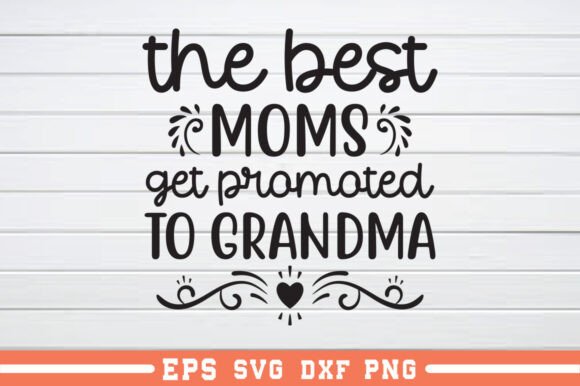
A Grandmother-Themed Graphic for Craft-Based Client Work
When a new design asset lands in my library, my first question is always whether it can hold its own in a real, paid project. It’s not about whether it’s cute; it’s about whether it’s capable. Opening The Best Moms Get Promoted to Grandma SVG, my immediate impression is one of warm, celebratory charm. This isn’t a sterile corporate graphic; it’s a piece with emotional resonance, built for projects that require a personal touch. The style leans into a classic, heartfelt aesthetic—the kind that feels instantly familiar and welcoming.
The Right Project Fit: Handmade Brands & Personal Celebrations
This SVG design wouldn’t be my pick for a tech startup’s website, but for a specific niche of client work, it’s exceptionally fitting. I picture it seamlessly integrating into the visual identity of a small, handmade business—an Etsy shop specializing in family-themed keepsakes, a local boutique preparing for a Mother’s Day or Grandparents Day event, or a blogger creating content around family legacy. It naturally supports design directions centered on celebration, gift-giving, and personal connection.
For a client launching a line of grandma-themed mugs or tote bags, this graphic could serve as the central decorative element. In packaging design for such a product line, it could become a repeated pattern or a focal point on the label, instantly communicating the product’s sentimental value. For a marketer crafting a social media campaign for a family-oriented brand, this asset provides a ready-made visual that elevates the mood beyond simple text posts.
Performance in Real Design Applications
In practical use, this design asset shines in specific applications. Its strength is as a decorative accent or a hero graphic in larger layout areas.
- Product Mockups & Merchandise: For t-shirt design, mug sublimation, or sticker creation, the clear, cut-ready SVG file is a direct advantage. It allows for clean integration into Cricut projects or print-on-demand templates.
- Printable Designs & Wall Art: As a focal point on an invitation, poster, or printable wall art, it establishes the thematic tone immediately.
- Social Media Graphics & Web Elements: Within a Canva template for an Instagram post or a Pinterest pin, it adds a polished, custom feel that generic fonts often lack. For a blog visual or website banner announcing a family-focused event, it provides instant visual appeal.
However, a professional designer must also note its limitations. This is not a asset for complex information hierarchy.
- Small Sizes & Crowded Layouts: The detailed, likely script-based typography may lose readability if scaled down too much or placed in a busy composition.
- Minimalist or Corporate Branding: Its inherently decorative and emotive style clashes with projects requiring ultra-clean, neutral, or strictly professional visuals.
- Low-Contrast Environments: Placing it on a similarly toned or textured background without careful contrast adjustment could render it ineffective.
Impact on Brand Perception & Audience Engagement
Using such a specific graphic in client work directly affects the final project’s perceived authenticity and emotional appeal. For a handmade business, it reinforces a crafted, personal brand identity. It builds visual trust with an audience seeking genuine, sentiment-driven products. The design’s celebratory mood fosters audience engagement by tapping into shared family values, making marketing visuals or editorial design feel more relatable and less transactional.
From a commercial design perspective, its professionalism hinges on execution. A well-integrated, properly scaled, and thoughtfully contrasted application makes the entire design feel deliberate and polished. A haphazard placement, however, could make the project look amateurish. The asset itself is a tool; the designer’s skill in applying it determines the outcome.
Essential Designer Checks Before Client Use
Before I would ever place this into a paid client’s project file, I run a series of practical tests. These are non-negotiable for any commercial design asset.
- Licensing: Confirm the commercial license allows for use in client work and physical product sales. This is the foundational step.
- Scalability & Editability: Open the SVG in vector software. Check that the paths are clean and editable for potential color or minor compositional adjustments to fit the brand palette.
- Readability Testing: Preview the design at both very large and very small sizes. Observe how the letterforms hold up at dimensions you might use for a product label versus a website hero image.
- Contrast & Color Tests: Place it on pure white, pure black, and a mid-tone background. Does it remain legible? Test a black-and-white version to ensure it works for print scenarios where color isn’t available.
- Context Mockups: Drop the graphic onto realistic mockups—a t-shirt, a mug, a blog header. Does it integrate well with other brand elements? Does it feel balanced?
- Style Comparison: Compare its aesthetic against a standard serif or sans-serif font. This confirms its role as a display font or illustrative element, not a body text replacement.
- Print Preview: If the project involves physical output, run a test print at high resolution to check for any unexpected thin lines or gaps that might not render cleanly.
Final Judgment: A Niche Asset with Clear Commercial Value
My review concludes that The Best Moms Get Promoted to Grandma SVG is a highly capable graphic design asset within its intended niche. It is not a universal tool, but for the right client project—those rooted in crafts, family celebration, handmade goods, and sentimental marketing—it adds significant value. It provides a ready-made visual centerpiece that can accelerate the design process while elevating the final product’s emotional resonance and perceived craftsmanship.
For graphic designers, brand owners, and digital sellers working in this space, it represents a practical addition to their library of commercial design assets. Its success depends on the designer’s mindful application of the fundamental checks: scalability, contrast, context, and licensing. When used with that professional rigor, it transforms from a simple downloaded file into a powerful component of effective, client-ready creative design.